
Needing help with online marketing?
The Shift From Search Rankings to AI Recommendations: What Tax and Accounting Firms Must Know
Share this post
For years, winning new clients online followed a predictable formula for accounting and tax firms: pick your keywords, chase a few backlinks, and fight for one of the blue links near the top of the results page. That formula is breaking down. The way people actually look things up has changed, and search engines are quietly turning into something closer to recommendation engines than ranking lists.
You could see it at this year's
Google I/O(2026), where the company leaned hard into AI overviews and conversational search. For any firm that has built its pipeline on traditional search engine optimisation (SEO), the goalposts have moved. Ranking first matters less than whether an AI tool decides to mention your firm by name when someone asks it for help.
What generative engine optimisation means for accounting firms
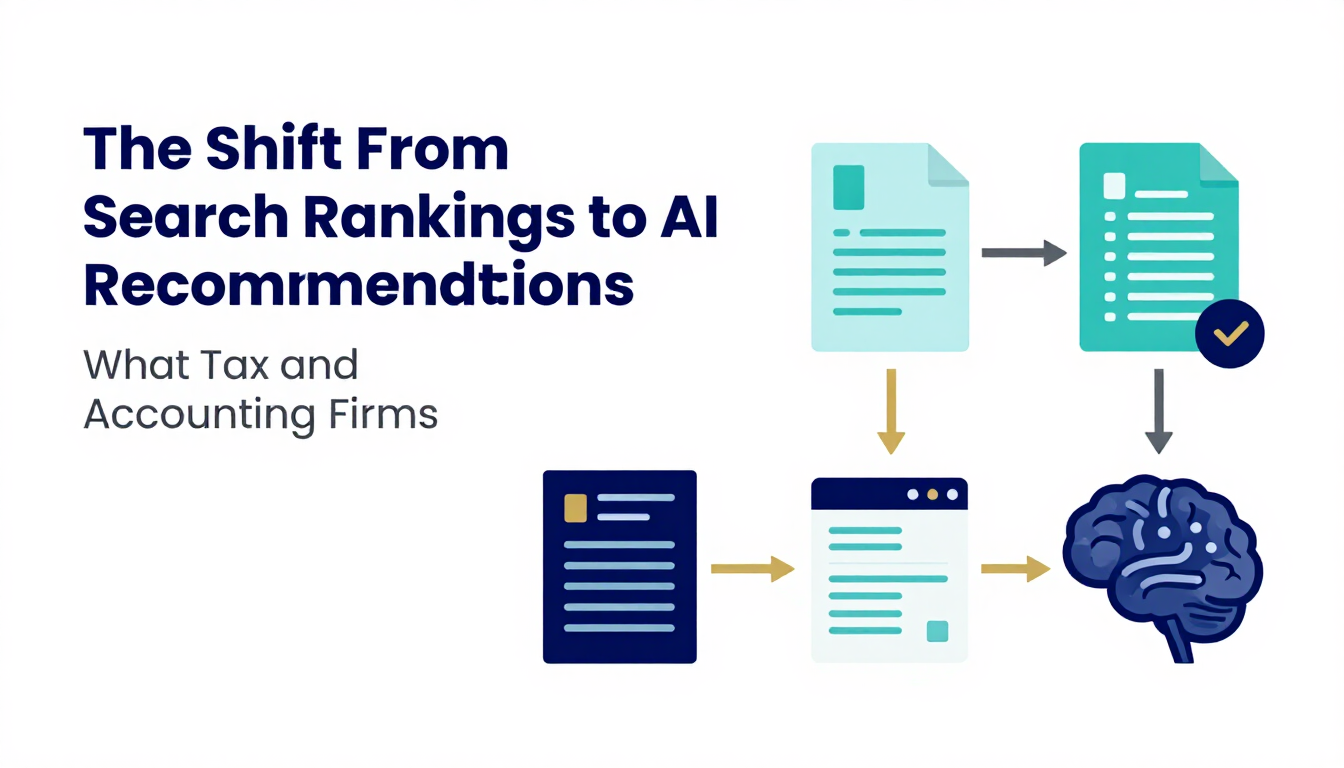
Tools like Gemini, ChatGPT and Perplexity are now where a lot of people start their research, and that's given rise to a companion discipline alongside SEO: generative engine optimisation, or GEO. Old-school SEO cared about things like keyword density and meta tags. Generative engines care more about context who you are, who you help, and whether the story you tell about yourself holds together across the web.
Tax and financial advice also sits inside what Google calls "your money or your life" content, the category it holds to a higher bar because getting it wrong can genuinely hurt someone. Clearing that bar takes more than a tidy website. AI tools look at the wider picture your professional directory listings, your reviews, your social profiles and cross-check all of it before they'll vouch for you in a recommendation.
Why template websites make accounting firms invisible
Plenty of accounting firms run on template websites and syndicated content handed to them by industry marketing providers. That was fine when the goal was simply getting indexed. It's a liability now.
When an AI tool reads across dozens of firms and keeps hitting the same stock photos, the same service blurbs and the same wording, it has no way to tell one from another. Nothing marks you out as different or specialised, so the tool does the easy thing and leaves you out of the conversation entirely. This is where a purpose-built accounting web design approach earns its keep a site written around your actual clients and specialisations gives AI tools something distinct to latch onto, rather than the same boilerplate every other firm is running.
According to Ben Feng, director of the Sydney-based accounting firm Hopkan Partners, success in this new environment requires a deliberate pivot away from generalised marketing speak toward radical clarity.
As Ben notes, "AI doesn't quote your cleverest sentence. It quotes your clearest one."
Ben discovered this dynamic firsthand while optimising his company's web presence for generative search. He adjusted his content structure to address client inquiries directly at the top of his pages, eliminating long introductory text. The result of these adjustments became apparent during branded search tests. Google's AI overview began generating an accurate, automated summary of his firm's specific services and target clientele, proving that the algorithm could successfully parse and trust the underlying data.
Why client reviews carry more signal than you think
Client reviews have always nudged local search rankings. The difference now is that AI tools read them for meaning, not just star counts. A glowing one-liner doesn't help a tool that's trying to answer a specific question.
| Review type | Example text | Impact on AI recommendation |
|---|---|---|
| Thin review | "Great accountant, highly recommend their services." | Confirms basic sentiment but gives the tool nothing specific to work with. |
| Expertise-signal review | "This firm helped our construction business with quarterly BAS and tax planning and saved us money." | Supplies industry context, location cues and a clear sense of what the firm actually does. |
You can steer clients toward this kind of detail when you wrap up a job a quick prompt about what you helped them with does the trick. When a tool keeps seeing the same language turn up across reviews from real, verified businesses, it gets enough confidence to put your name forward for narrower searches like "construction tax specialist near me".
A 90-day plan for accounting firms to get ready
Adapting to AI-led discovery isn't a technical project so much as a discipline. Over the next 90 days, most firms can get a long way by focusing on four things:
Pick a lane. AI tools reward depth over a long list of generic services. Spelling out what you genuinely know property investors, medical practices, hospitality, trades — gives you an identity worth recommending.
Answer questions directly. Go through your website copy and check it actually responds to what clients ask. Use real questions as your headings, then answer each one in a sentence or two right underneath.
Tidy up your details everywhere. A business name, address or phone number that's slightly different on your Google Business Profile, Facebook and directory listings reads as unreliable. Make them identical across the board.
Add schema markup. Local business and FAQ schema in your site's code helps AI tools read your location, services and hours cleanly, without guessing. It's the one genuinely technical item on the list, and it's worth handing to whoever builds your accounting firm's website.
Leaning on a static website and a handful of keywords doesn't cut it anymore. As more people let an AI tool do the first round of searching for them, the firms that say plainly who they help, how they work and what they're best at are the ones that'll keep showing up.
Ready to make your firm visible to AI search?
Most accounting firms won't lose ground because their advice is poor they'll lose it because their website gives AI tools nothing to recommend. If your site still reads like every other firm's, now is the time to fix it. At Social Space, we build accounting websites designed to be found and recommended in an AI-driven search landscape clear, specialised, and structured the way these tools actually read.
Get in touch to talk through your accounting web design and give your firm something worth quoting.

About Social Space
Hey there, I'm Robert Tickner!
I’m an online visibility consultant who helps local small businesses get noticed on Google search, guiding them on their digital journey for growth. I build websites with structured web design practices through SEO services that get noticed on Google's search algorithms, write the occasional blog, and boost Google Business Profile listings to improve overall traffic that helps convert more potential clients to your website.

I'm determined to grow my business.
My only question, is it time to boost yours?