Needing help with online marketing?
A Pretty Website Isn't Enough Anymore: Is Your Website Working for You?
Share this post
You've invested in a professional website. It looks polished, the colours match your brand, and the photography is crisp. Yet enquiries are trickling in slower than expected, and you're watching competitors with clunky designs somehow win more business. Sound familiar?
Here's the uncomfortable truth: a beautiful website that doesn't convert is just an expensive digital brochure.
Discover three hidden website flaws costing your small business revenue every single day—and how to fix them before your competitors do.
Flaw #1: Your Website Doesn't Speak Your Customer's Language (Literally)
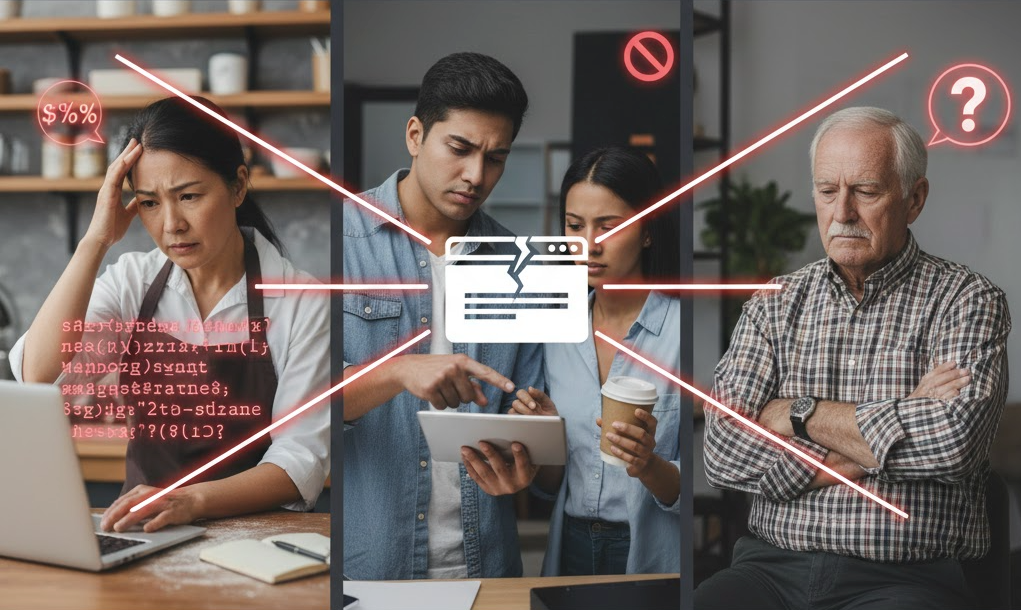
Most businesses make a fatal assumption: they write their website copy for themselves, not for their customers. The result? A disconnect so wide that potential buyers leave within seconds, confused about whether you can actually solve their problem.
Think about the last time you visited a website and saw phrases like:
"We provide comprehensive digital solutions" or "Delivering synergistic outcomes through innovative methodologies."
What does that actually mean? More importantly, is that how your customers describe their problems when they're searching for help?
The gap between industry jargon and customer language kills conversions faster than almost anything else. When someone needs help with their broken laptop, they're typing "laptop won't turn on" into Google—not "requiring technical support for hardware malfunction resolution."
This isn't just about search engine optimisation (though that matters too—if you need help with visibility, specialists like this SEO Stockport company can guide you). This is about the fundamental way you communicate value to people who are ready to buy.
Here's a quick test: Open your homepage right now. Read the headline and first paragraph aloud. Would your ideal customer use those exact words to describe their problem? If not, you're already losing them.
The Fix:
Interview five recent customers and ask them how they described their problem before finding you. Use their actual words in your headlines and service descriptions. Stop trying to sound impressive and start trying to sound understood.
Replace "We specialise in commercial property maintenance solutions" with "We fix broken equipment in offices and warehouses—fast."
Replace "Holistic wellness coaching for optimal health outcomes" with "I help busy parents lose weight without giving up the foods they love."
The difference is clarity. And clarity converts.
Flaw #2: Your Contact Points Are Buried or Broken
This one stings because it's so easily fixable, yet astonishingly common. People arrive at your website ready to buy, and then… they can't figure out how.
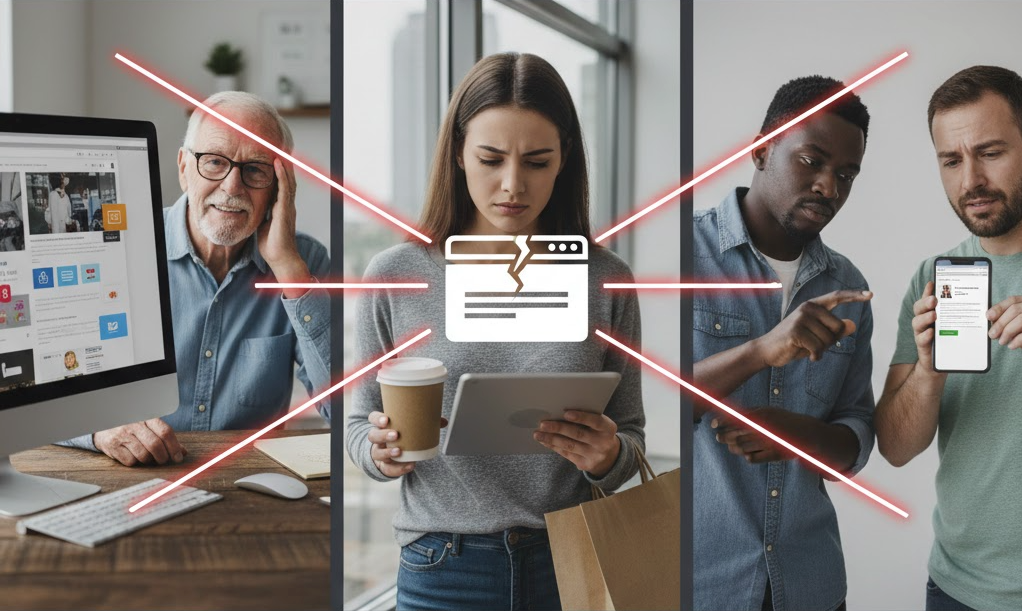
Your contact form is hidden three clicks deep. Your phone number lives in the footer, using a font size that requires squinting. Your "Get Started" button doesn't actually explain what happens when someone clicks it. Or worse—your contact form doesn't even work, and you've been missing enquiries for weeks without realising it.
Here's what happens in the mind of your visitor: they've done their research, compared options, and decided you might be the right fit. But now they're faced with a scavenger hunt just to reach you. What do they do? They hit the back button and choose your competitor instead. Because buying should never be harder than browsing.
You've likely heard of the "three-click rule"—the myth that users will abandon your site if they can't find what they need within three clicks. That's not quite right. The real rule is simpler: if the path to action isn't obvious, you've already lost.
Think about your own behaviour online. When you're ready to book a restaurant, request a quote, or schedule a consultation, how patient are you with websites that make it difficult? Exactly.
The Fix:
Test your website like a stranger would. Better yet, ask someone who's never seen it before to find your contact information and submit an enquiry. Time them. If it takes longer than 30 seconds or requires any thinking, you have friction points.
Make your phone number clickable and visible on every page—especially mobile. Add clear, specific calls-to-action above the fold: "Book Your Free Consultation," "Get a Quote in 60 Seconds," "Call Now 0450 616 000"
And for the love of revenue, test your contact forms monthly. Send yourself a test message. Check your spam folder. Ensure autoresponders are working. You'd be shocked how many businesses are silently bleeding enquiries because of a technical glitch they don't know exists.
Your Website Treats All Visitors the Same
Here's a scenario: Someone visits your website for the first time, knowing nothing about you. At the exact same moment, a returning customer who's bought from you three times before also visits. They see the exact same homepage. The exact same generic message. The exact same undifferentiated experience.
Does that make sense? Of course not.
Yet this is how 95% of small business websites operate.
Your website tries to be everything to everyone, and in doing so, it speaks to no one effectively. Your homepage attempts to simultaneously introduce your company, showcase services, appeal to different customer types, tell your story, and push for a sale—all in one overwhelming scroll.
Think about walking into a shop. An attentive shopkeeper would treat a first-time browser differently than a regular customer. They'd ask questions. Understand needs. Tailor the conversation. Your website should do the same, even in simple ways.
Different visitors have different needs. Someone researching options needs education and trust-building. Someone comparing prices needs clear differentiation. Someone ready to buy needs a frictionless path to purchase. One static homepage cannot effectively serve all three.
The Fix:
You don't need expensive personalisation software to fix this. Start with targeted landing pages for different audiences or traffic sources.
If you run Google Ads or social media campaigns, don't send people to your generic homepage—create dedicated landing pages that speak directly to what they clicked on. If your ad promises "Fast Plumbing Repairs in Manchester," the landing page should say exactly that, not force them to navigate through your full service menu.
Create separate pages for first-time visitors versus returning customers. Use your email campaigns to drive people to content that matches where they are in the buyer journey—educational blog posts for early-stage researchers, case studies for those comparing options, and streamlined contact pages for those ready to commit.
Even simple changes make a difference. Add a welcome message for new visitors. Offer returning visitors quick access to their account or previous orders. Segment your services by customer type (homeowners vs. landlords, startups vs. enterprises).
When visitors feel like your website "gets them," they stay longer, engage deeper, and convert more often.
A Website Should Work As Hard As You Do
A pretty website might impress colleagues or win design awards, but it won't pay your bills. Your website's job isn't to look good—it's to convert visitors into customers, reliably and measurably.
The three flaws above are hidden in plain sight. They don't show up in analytics as obvious errors. They don't trigger warning messages. They just quietly cost you money, day after day, as potential customers slip through the cracks.
The good news? These aren't expensive fixes. They don't require a complete redesign or a massive budget. They require a shift in perspective—from thinking about your website as a digital brochure to treating it as your hardest-working salesperson.

About Social Space
Hey there, I'm Robert Tickner!
I’m an online visibility consultant who helps local small businesses get noticed on Google search, guiding them on their digital journey for growth. I build websites with structured web design practices through SEO services that get noticed on Google's search algorithms, write the occasional blog, and boost Google Business Profile listings to improve overall traffic that helps convert more potential clients to your website.
I'm determined to grow my business.
My only question, is it time to boost yours?